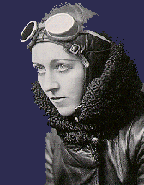
 Amy was born at 154 St George's Road, Hull. The date was July 1st, 1903 - the
same year that Wilbur and Orville Wright made the first successful controlled,
powered flight, in a heavier-than-air craft. It would be another three years
(1906) before anyone else flew in an airplane.
Amy was born at 154 St George's Road, Hull. The date was July 1st, 1903 - the
same year that Wilbur and Orville Wright made the first successful controlled,
powered flight, in a heavier-than-air craft. It would be another three years
(1906) before anyone else flew in an airplane.
In the early years of aviation history, Amy Johnson was a ground-breaking pioneer, establishing several long-distance records. The first of these came in 1930, when she took to the sky determined to successfully complete the flight from Croydon, London, to Darwin, capital of the Northern Territory of Australia.
Imagine Amy's feelings as she embarked upon such an adventure, in an age when very few people in the world had seen a TV screen or heard the disembodied voice of another human being through a telephone; at a time when British women had won full voting rights only two years earlier.
She set off for the 11,000 mile journey in a second-hand D H Gypsy Moth on May 5th, arriving in Darwin 19 days later on May 24th, and in doing so, became the first woman to fly alone to Australia.
Her father, John William Johnson, was involved in Hull's primary industry as market salesman for the family business, Andrew Johnson, Knudtzon & Co., fish merchants, and it was he and Lord Wakefield who financed the £600 purchase of the Gypsy Moth. Amy decided to christen the plane Jason, a contraction of 'Johnson', the registered trademark of the family firm.
Amy lived in Hull until she went to Sheffield University in 1922. After one or two hiccups, she was finally awarded a BA in Economics, Latin and French in July of 1925.
After graduating, she moved to London, working in a solicitor's office as a secretary. It was in London that she became interested in flying, and began learning the skills of a pilot at the London Aeroplane Club towards the end of 1928, gaining her Pilot's 'A' Licence on July 6th, 1929. Later that same year, on December 10th, she was issued with a Ground Engineer's 'C' Licence, and for a while became the only woman in the world holding a valid Ground Engineer's Licence. Flying had become the passion of her life. Ultimately, it would be this passion that killed her.
On January 5th, 1941, on a routine flight as a pilot for the Air Transport Auxiliary, Amy's plane plummeted towards the Thames Estuary. She was forced to bail out and although she and her parachute were sighted, her body was never recovered, and she was assumed to have drowned. She was 37 years old.
Amy Johnson was one of the courageous pioneers of aviation history who
helped to make the world a smaller place. She smashed through the barriers
of gender and stereotype that were prevalent at the time, playing an early
role in the struggle for the emancipation of women that still continues today.